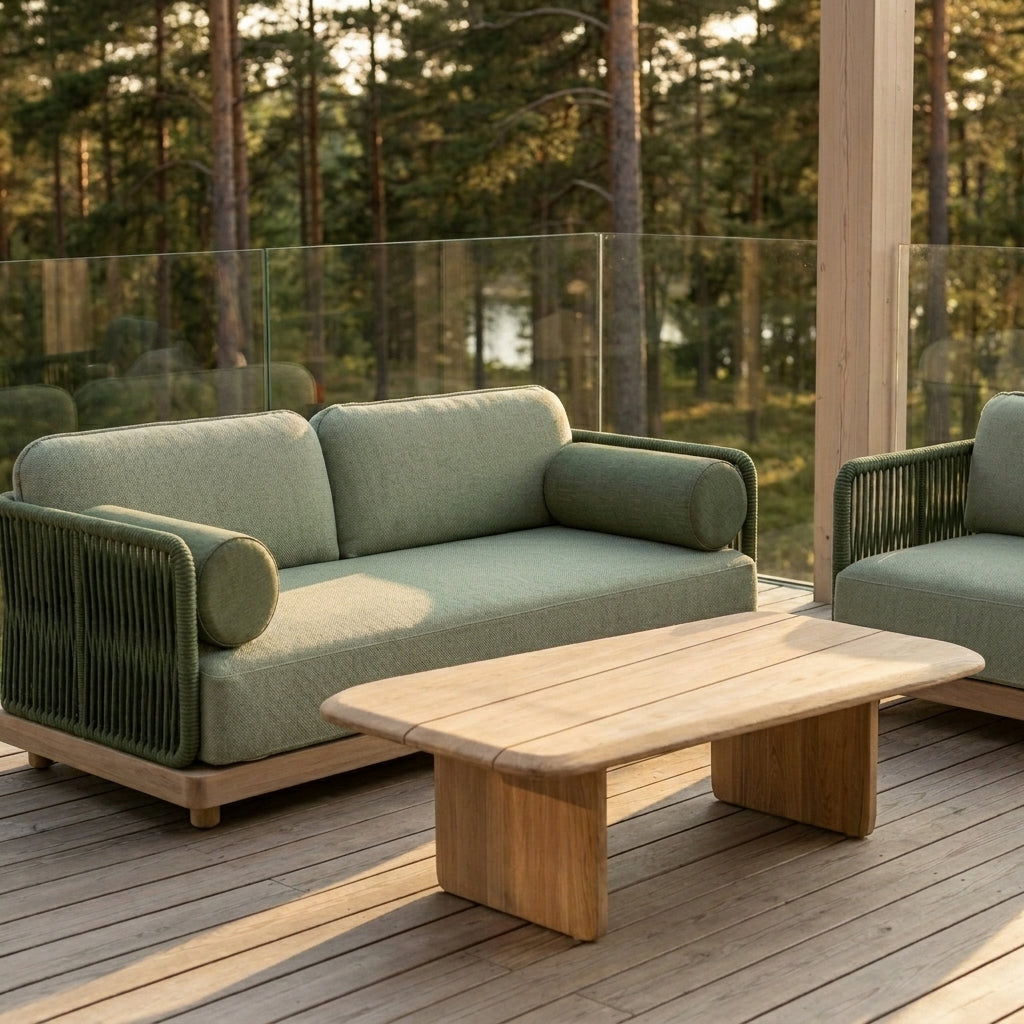
Early autumn brings something to spatial design that cannot be orchestrated at the height of summer: a drastic change in the angle of incident light. The July sun at 1 p.m., shining almost vertically from above, can be ruthless. It flattens forms, burns out colors, and creates deep, black patches directly under tree crowns or canopies.
When September welcomes us to the garden, the sun descends lower toward the horizon. The rays strike at a sharp angle, and the light becomes soft, warm, and three-dimensional. For a landscape architect, this is not a matter of mood, but a compositional tool that verifies the accuracy of the materials used, the layout of sightlines, and plant structure.
How can we utilize this short but incredibly malleable moment of the year so that a project gains depth that isn’t visible in two-dimensional renders?
1. Backlit design
The low angle of the sun makes reflected light give way to transmitted light. Things that were simply green or colorful patches in midsummer begin to act as natural stained glass in early autumn.
A well-thought-out sightline, connecting the main observation point (e.g., floor-to-ceiling living room windows or a covered terrace) with the direction of the setting autumn sun, can completely transform the perception of a garden.
Leaves as light filters: Species with thin, delicate leaf blades (like selected varieties of maples, sweetgums, or katsura trees) backlit from behind create an extraordinary illusion of depth.
Plumes and panicles: The airy inflorescences of tall ornamental grasses, fountain grasses, or feather reed grasses collect the low light, creating a luminous, soft optical barrier that separates zones without the use of solid walls.
When plotting the cardinal directions on a plan, it is worth analyzing not only where the building itself casts a shadow, but also where the light point will be between 4:30 PM and 6:00 PM. Placing a transparent, textured plant structure there will create an effect that no artificial spotlight can provide.
2. Micro-shadows and the theater of textures
In the scorching summer sun, the difference between smooth concrete and handcrafted stone with a rough surface can blur. The low, horizontal rays of the autumn sun bring out every millimeter of micro-structure.
A ray striking at a sharp angle creates a dense grid of micro-shadows. It is precisely during this period that differences in materials become most expressive:
Brushed wood and hewn stone reveal their full, sculptural character.
Raw, rusted steel and structural plasters gain a deep, saturated shade.
Flat, monolithic planes begin to look more noble if their surface has even minimal grain.
If a design includes materials with complex textures, it is worth exposing them in places where the autumn sun slides across them flatly, rather than illuminating them head-on.
3. Shadow as a standalone drawing on the surface
In landscape design, shadow is usually treated as a zone of relief from the heat. In autumn, however, shadow becomes a full-fledged graphic element that draws upon surfaces.
Long, exaggerated shadows of tree trunks, vertical slats, openwork fences, or canopies lie on large-format slabs, smooth concrete, or fine gravel like a vivid pattern.
Placing several trees with interesting bark (e.g., birch with white or peeling bark, or cherry trees) at the appropriate distance from a light-colored wall or surface causes the low sun ray to cast a dynamic drawing on the plane that changes from minute to minute.
4. Structural beauty when color disappears
The greatest test for an architect is the moment when a plant finishes blooming and the leaves fall. A well-designed space does not fall apart aesthetically in October and November.
When intense colors disappear, the architecture of the plant comes to the fore:
Skeleton and habit: The rhythm of branches, the shape of the crown, and architectural stems.
Seed pods and ears: Dried discs, spheres, and panicles that, in the low sun and morning dew, create sculptural details on a microclimate scale.
Designing with the autumn and winter silhouette in mind requires moving away from "color patches" toward thinking in terms of graphics, lines, and density contrasts.
Light as a full-fledged building material
Lighting analysis at the concept stage is often limited to checking sun exposure conditions for the purpose of selecting plant species. However, treating light—especially low, transition-period light—as a physical finishing material allows for the creation of designs that reach their greatest maturity precisely when most gardens are falling into their winter sleep.
Learn more